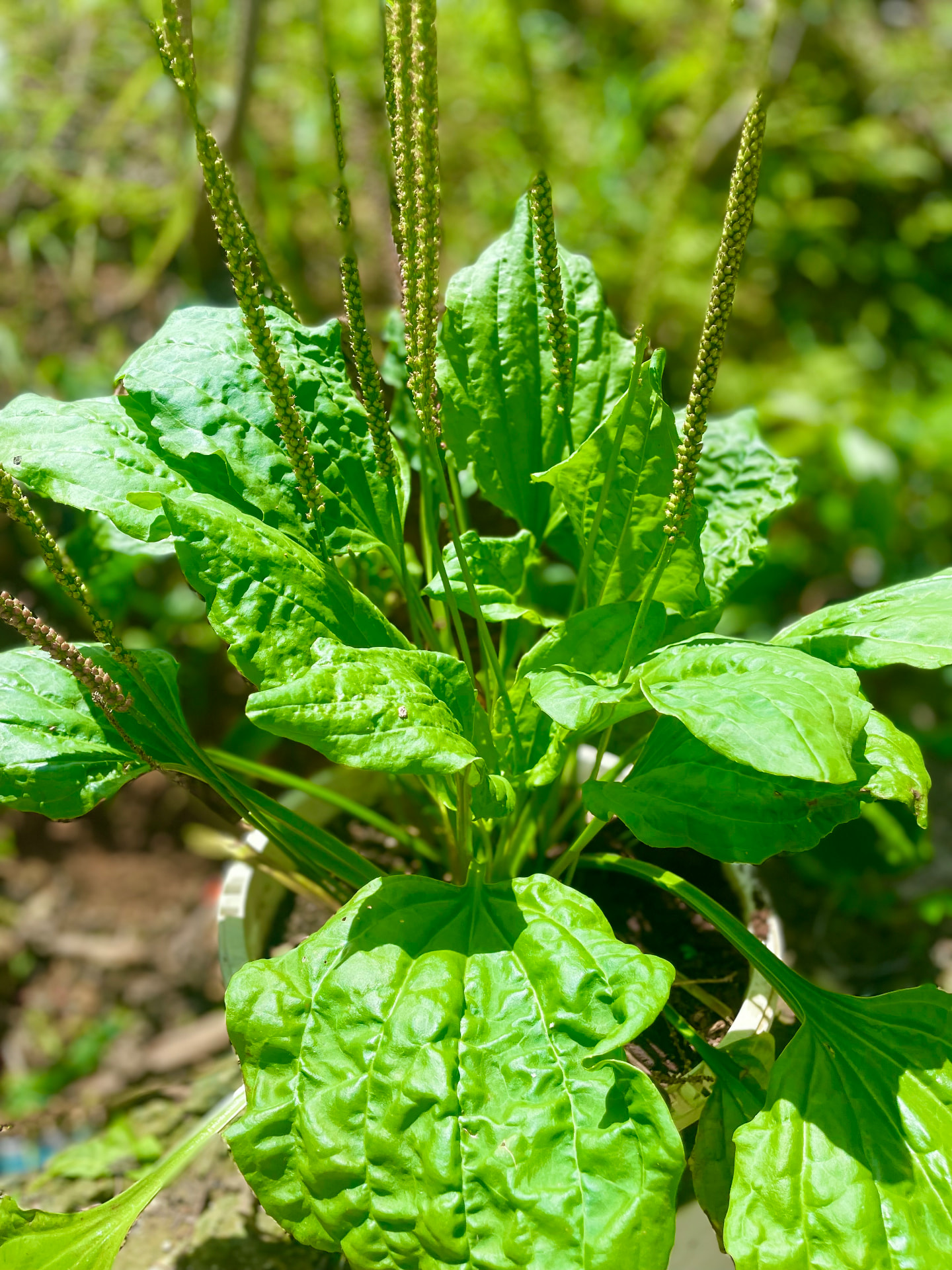
About the speciesAbout the species: a mature llantén rosette with seed spikes rising from the crown. This listing is for SEEDS — no plant is included.
Cilantro, Culantro & Herbs
Llantén Seeds – Broadleaf Plantain
Plantago major L.
Llantén • Broadleaf plantain • Common plantain
$5.89for 200 Seeds
SEEDS FOR PLANTING
FREE SHIPPING
In stock — packed and shipped within 1–2 business days
SEEDS ONLY — no live plant is included. Select your quantity above; free shipping applies to every option.
Choose your pack size
Home garden
Grower pack
Bulk
Free shipping applies to every pack size.
1
Llantén (Plantago major) seeds for planting — the broad-leaved, strongly veined herb of paths and dooryards, grown in traditional herb and ethnobotanical gardens. 200 to 1,000 seeds, free shipping.
- Free shipping on this listing
- Secure encrypted checkout
- Carefully packed in Puerto Rico
- Detailed growing guide included
- Scientific name
- Plantago major L.
- Family
- Plantaginaceae
- Growth form
- Low basal rosette, perennial in mild climates
- Product type
- Seeds for planting
- Light
- Full sun to partial shade
- Sowing
- Surface sow — press in, do not bury
- Germination
- Often about 1–3 weeks; timing varies with warmth and moisture
- Water
- Keep the surface evenly moist until seedlings establish
- Soil
- Tolerates a wide range, including compacted ground
- Height
- Leaves low; seed spikes commonly rise above the rosette
You have probably walked past llantén hundreds of times without knowing its name. It grows flat against the ground at the edges of paths, driveways and garden beds — the kind of plant most people step over rather than look at.
Look down once and it becomes hard to unsee: a rosette of broad leaves, each one crossed by strong parallel veins that run from base to tip, with thin spikes standing above them.
Those spikes are the reason this listing exists. Each one carries many tiny flowers and, later, a great number of very small seeds.
Choose the quantity that fits your project — 200, 400, 600, 800 or 1,000 seeds. Every option ships free.
What You Receive
- 200 Plantago major (llantén) seeds
- Seeds only — not a live plant
- FREE SHIPPING
- Link to the complete Llantén Growing Guide
SEEDS ONLY — no live plant is included. Select your quantity above; free shipping applies to every option.
Read before you buy
Plantago major is not the plantain banana. The banana-type plantain belongs to the genus Musa and has nothing botanically in common with this herb beyond a shared English name.
Alpha Tropic sells llantén as a botanical, ethnobotanical and edible-plant garden subject. No medicinal claim, health benefit or therapeutic use is stated or implied, and nothing here is advice about treating any condition.
Plantago major self-seeds readily in suitable conditions. Decide where you want it before you sow, and read the seed-spike note further down the page.
From something this small
Starting llantén seed
- 1
Prepare a fine surface
Fill a tray or pot with a fine, firmed seed-starting mix and level it. Lumpy medium swallows seed this small.
- 2
Sow on the surface
Scatter the seed thinly across the top. Press it into contact with the medium rather than covering it — light on the surface is part of what these seeds respond to.
- 3
Keep the top layer damp
Mist or bottom-water so the surface never dries out. A drying surface is the most common reason a surface sowing fails.
- 4
Wait and watch
Seedlings often appear within roughly one to three weeks depending on warmth and moisture. The first true leaves are already recognizably ribbed.
- 5
Thin, then grow on
Thin crowded seedlings and give each plant room to spread its rosette. Full details are in the growing guide.
CORRECT ✓
Seed pressed onto the surface of a fine, firmed, evenly damp medium with good light.
AVOID ✕
Seed buried under soil, sown into coarse lumpy mix, or allowed to dry out between waterings.
Look closer at the leaves
The leaf is the identification. Broad, oval to egg-shaped, thick-textured, held in a flat rosette close to the ground — and crossed by several strong parallel veins that run the whole length of the blade rather than branching out like a net.
Tear a leaf gently across and those veins hold on as fine threads. Growers notice it immediately; it is the detail that separates llantén from the round-leaved weeds it often grows beside.
Those long spikes are more interesting than they look
What rises above the rosette looks like a plain green stalk. It is actually a dense spike of many small, individually inconspicuous flowers, opening in sequence along its length.
As they finish, the spike fills with seed — a single mature plant can carry a remarkable number of them, which is exactly why a 200-seed packet is a generous starting point rather than a token.
The tiny seeds inside those mature spikes are what eventually produce the broad rosettes shown in the species photographs.
A small plant with a very long human history
Plantago major travels with people. It established itself along footpaths, cart tracks, dooryards, pastures and cultivated ground far beyond its original range, to the point that several cultures named it after the paths where it appeared.
Its young leaves have been eaten as a cooked or salad green in various food traditions, and it holds a long-documented place in folk herbal practice across Europe, the Americas and beyond.
That history is why it turns up in ethnobotanical collections today — as a plant with a documented cultural record, described here as history rather than as a health recommendation.
Why people still grow llantén
- Traditional herb gardens, where it is one of the oldest documented entries
- Ethnobotanical and teaching collections
- Edible-plant gardens, where young leaves are used as a cooked green where appropriate
- Seed-saving, since spikes are easy to harvest by hand
- Simple botanical curiosity — watching a rosette turn into a seed-spike factory over one season
What you receive
- Your selected quantity: 200, 400, 600, 800 or 1,000 Plantago major seeds.
- Seeds only — no live plant.
- Free shipping on every quantity.
One plant, two very different “plantains”
Broadleaf plantain is Plantago major, a small ground-level herb in the family Plantaginaceae.
The plantain you cook and fry is a Musa species — a large tropical herbaceous plant in the banana family, Musaceae.
They share an English word and nothing else. In Spanish the distinction is cleaner: llantén versus plátano.
Before you let every spike mature…
One practical decision shapes how llantén behaves in your garden: what you do with the spikes.
If you want your own seed, leave a few selected spikes to ripen fully on the plant and cut them when they turn dry and tan.
If you would rather not find seedlings across the bed next season, cut the spikes before the seed matures and disperses. It takes a minute and it is far easier than editing volunteers later.
Why grow it
Why grow llantén?
Plantago major — the true broadleaf plantain, not the banana
Broad, strongly parallel-veined leaves in a flat rosette
Tall seed spikes carrying very large numbers of tiny seeds
One of the most widely documented herbs in traditional gardens
Easy surface sowing — no soaking or scarification
200 to 1,000 seeds, free shipping on every quantity
You may also like
Related products
15 Fresh Inga spectabilis Seeds – Guamá / Guaba Machete / Ice Cream Bean
Inga spectabilis (Vahl) Willd.
$22.89