
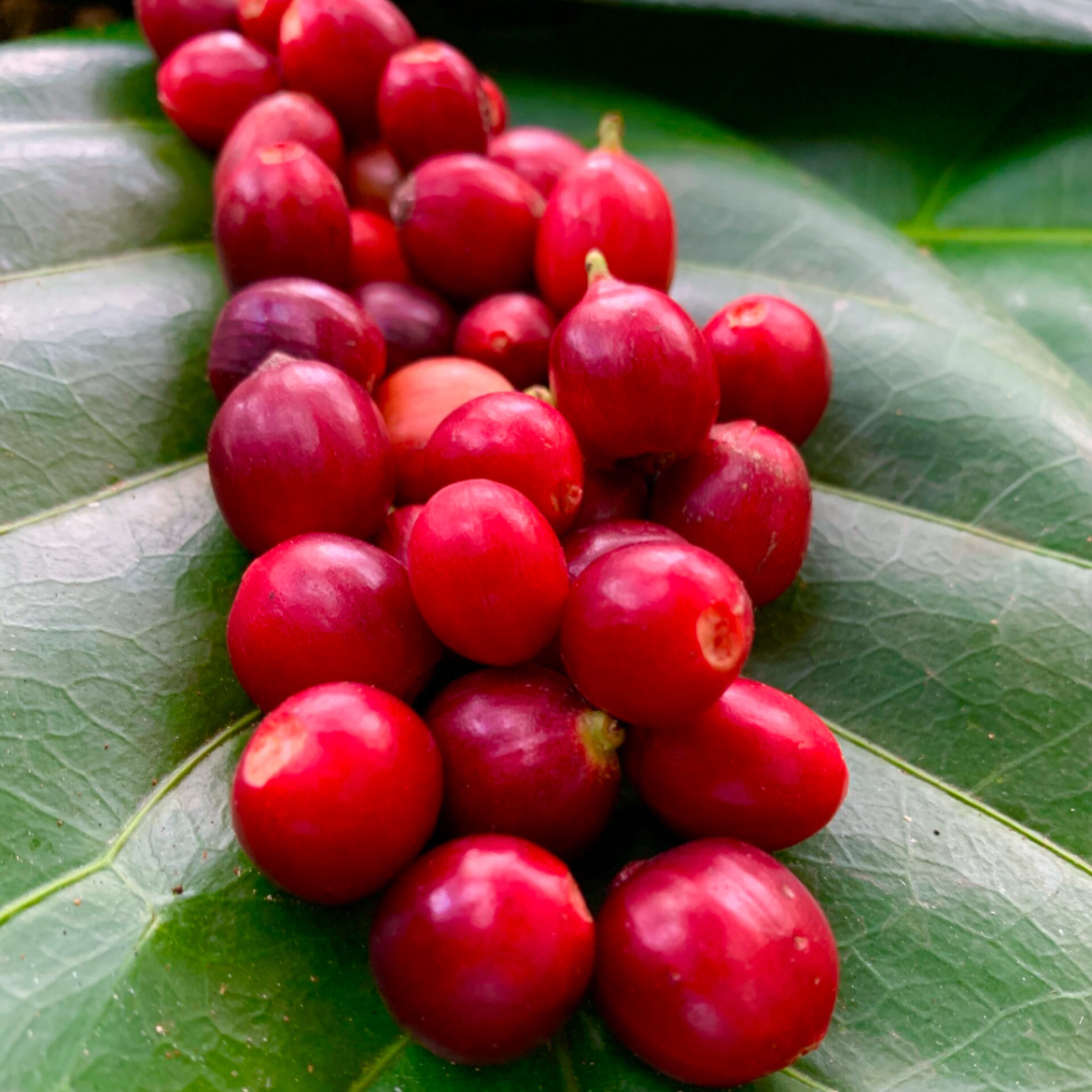
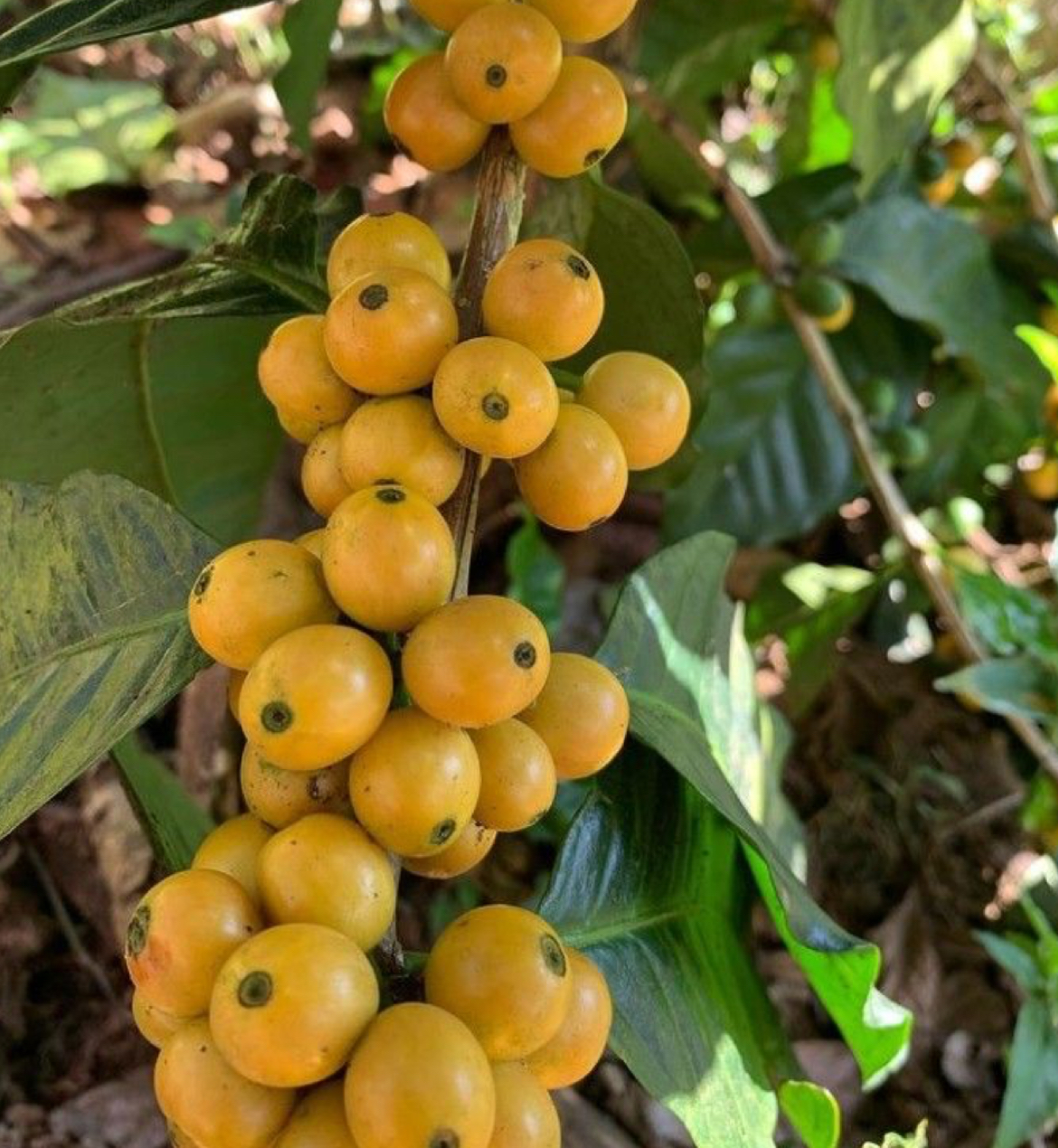
About the speciesABOUT THE SPECIES — Ripe yellow Coffea arabica cherries from Puerto Rico. The coffee seeds sold here come from this yellow-fruited source type. Cherries shown for identification; fruit is not included.
Rare Tropical Fruit
15 Germinated Yellow Arabica Coffee Seeds
Coffea arabica L.
Yellow-Fruited Arabica • Café Arábica Amarillo • Puerto Rico
$16.98for 15 germinated seeds
GERMINATED SEEDS
FREE SHIPPING
In stock — living germinated seeds, packed and shipped within 1–2 business days
15 GERMINATED SEEDS · $16.98 · FREE SHIPPING · Puerto Rico. These are germinated seeds — NOT dry coffee beans. You are buying living planting material, not roasted coffee, green coffee for beverage processing, dry dormant seed or a potted plant.
1
15 germinated Coffea arabica seeds from Puerto Rico, sourced from coffee plants whose ripe cherries mature yellow rather than red. Living planting material — free shipping and the full Arabica coffee growing guide.
- Free shipping on this listing
- Secure encrypted checkout
- Carefully packed in Puerto Rico
- Detailed growing guide included
- Scientific name
- Coffea arabica L.
- Family
- Rubiaceae
- Plant type
- Tropical evergreen shrub / small tree
- Quantity
- 15 germinated seeds
- Origin
- Puerto Rico
- Cherry color
- Yellow at maturity (source plants)
- Cultivar
- Not confirmed — sold simply as Coffea arabica
- Climate
- Tropical highland origin; warm, frost-sensitive
- Light
- Bright filtered light / partial shade when young; acclimate gradually
- Water
- Consistently moist, never waterlogged
- Soil
- Airy, organic-rich, slightly acidic, free-draining
- Germination
- Already germinated — growth continues within days of planting
- Difficulty
- Easy to Moderate
- Important
- Living germinated seed — plant promptly and protect the radicle
Coffee is usually encountered at the very end of its journey — roasted, ground and brewed. This listing lets the grower begin at almost the opposite end of that story.
These are 15 germinated Coffea arabica seeds from Puerto Rico, sourced from coffee plants whose ripe cherries develop a yellow coloration rather than the more familiar red.
Each germinated seed represents the beginning of an evergreen tropical coffee plant: first establishing its root system, then developing the young seedling that can eventually mature into the glossy-leaved shrub or small tree responsible for one of the world's most recognizable crops.
Coffea arabica is far more botanically interesting than the familiar "coffee bean" suggests. The bean is actually the seed found inside the coffee cherry. Under typical development a cherry commonly contains two seeds positioned flat-face to flat-face, though natural variations occur.
The yellow color of the parent cherries gives this offering a distinctive visual identity, but it should not be confused with a confirmed cultivar name. These are seed-grown plants, and natural genetic variation should be expected.
This listing is for 15 GERMINATED SEEDS — not dry dormant seeds, not a live potted plant, and not coffee for roasting, brewing or consumption.
What You Receive
- 15 GERMINATED Coffea arabica seeds
- Yellow-fruited Arabica source plants
- Puerto Rico provenance
- Living, germinated planting material packed moist
- FREE SHIPPING
- Access to the Alpha Tropic Arabica Coffee Growing Guide
15 GERMINATED SEEDS · $16.98 · FREE SHIPPING · Puerto Rico. These are germinated seeds — NOT dry coffee beans. You are buying living planting material, not roasted coffee, green coffee for beverage processing, dry dormant seed or a potted plant.
Germinated Seed Notice
These seeds have already begun the germination process, so they must be treated differently from ordinary dry seed. Some will show a small white root (radicle); others will be swollen and about to break.
Handle the emerging root carefully and plant promptly after arrival. Do not leave germinated seeds exposed to dry air, excessive heat or physical damage, and do not store them dry or refrigerated.
Coffee cherries shown in the photographs are NOT included. This product is not intended for roasting, brewing or consumption.
The exact cultivar has not been confirmed. Yellow cherry color is an observable fruit characteristic and is not sufficient by itself to identify a coffee cultivar, so these are sold simply as Coffea arabica — Yellow-Fruited Arabica.
Germination
Planting germinated coffee seeds
- 1
Unpack promptly
Open the package the day it arrives and check the seeds. Keep them in their moist packing material, shaded and at room temperature, until planting — ideally the same day.
- 2
Identify the emerging root
Look for the small pale radicle emerging from the seed. Never remove, trim or straighten it; it is the plant's first and most important root.
- 3
Prepare containers before handling seeds
Fill small pots or deep seedling cells (one seed each) before touching the seeds so the roots spend minimal time exposed to air.
- 4
Use an airy, moisture-retentive medium
A light, organic-rich, slightly acidic mix works best: quality potting soil or coco coir with perlite, plus some compost. It should hold useful moisture while draining freely.
- 5
Handle the seed, not the root
Hold each seed by its body. If seeds are stuck together in the packing material, tease them apart slowly rather than pulling, and never bend an established radicle sharply.
- 6
Orient the root downward
Where practical, set the seed so the radicle points down into the medium. If no root is visible yet, lay the seed flat with the grooved side facing down.
- 7
Plant shallowly
The seed should sit roughly 0.5–1 cm (¼–½ inch) below the surface, just covered with loose medium. Deep burial is one of the most common causes of failure.
- 8
Water, drain, then keep evenly moist
Water thoroughly and let all excess drain. Afterwards keep the medium like a wrung-out sponge — moist, never saturated, never bone dry.
- 9
Warmth and protected light
Keep pots warm, roughly 70–85°F (21–29°C), in bright filtered light or shade. Direct midday sun will cook a newly planted seed or scorch a young seedling.
- 10
Hold off on fertilizer
Germinated seeds and very young seedlings do not need feeding. Wait until several true leaves have formed, then feed lightly.
CORRECT ✓
Seed just covered by 0.5–1 cm of moist, airy, free-draining medium, radicle pointing down, kept warm and in bright protected light.
AVOID ✕
Seed left to dry before planting, buried deeply, planted root-up, bent radicle, soggy medium, or a young seedling pushed straight into full tropical sun.
Botanical spotlight — coffee is a fruit
The familiar coffee "bean" is botanically a seed, and it grows inside a small fruit called a coffee cherry.
Working inward, a cherry consists of the outer skin, the sweet fruit flesh or pulp, protective inner layers including a mucilage layer, a papery parchment enclosing each seed, and finally the coffee seed itself under a thin silverskin.
A typical cherry commonly develops two seeds whose flattened surfaces face one another, which is why roasted coffee beans usually show one flat side with a central groove.
Occasionally a cherry develops only a single rounded seed, known in coffee terminology as a peaberry. This is shared as educational information — the seeds sold here are not identified or sold as peaberries.
From flower to yellow cherry
The white flowers of Coffea arabica are fragrant and short-lived, often lasting only a few days before petals drop and fruit set begins.
Flowering is closely associated with environmental conditions. In many coffee-growing environments, rainfall following a comparatively dry period can stimulate a flush of flowering — but climate, plant maturity and management all affect timing, so this is a tendency rather than a schedule.
- Coffee develops clusters of white flowers along its branches.
- Successful flowers set small green fruits.
- The cherries enlarge while remaining green through development.
- As this yellow-fruited source type reaches maturity, the exterior transitions toward yellow.
- Inside the mature fruit are the seeds people recognize as coffee beans after processing and roasting.
Why are some Arabica cherries yellow?
Coffea arabica contains substantial cultivated genetic diversity, and fruit color at maturity differs among genetic lines. The familiar ripe red cherry is not the only possible expression: some Arabica plants mature to yellow fruit.
The difference comes down to fruit pigmentation and the genetics behind it, rather than any difference in species. Red-fruited and yellow-fruited coffee are both Coffea arabica.
Visual fruit color alone cannot reliably establish a named cultivar. That is why Alpha Tropic identifies this product conservatively as Coffea arabica — Yellow-Fruited Arabica, rather than inventing a cultivar identity such as Yellow Bourbon, Yellow Caturra or Catuaí Amarelo.
Nor does yellow fruit automatically mean rarer, sweeter, higher quality, more caffeinated or more valuable coffee. It is a fruit characteristic, presented honestly.
Grown from Puerto Rican coffee
Coffee has long been an important agricultural crop in Puerto Rico, particularly across the mountainous interior where elevation, rainfall, temperature and local microclimates shape how coffee is grown.
Coffea arabica is the species most closely associated with the island's coffee production history, and these germinated seeds were produced from coffee grown in Puerto Rico and germinated here before shipping.
No municipality, farm, protected origin, certification or cultivar is claimed. The provenance stated is simply this: Puerto Rico, from plants that ripen yellow cherries.
From germinated seed to coffee seedling
- Radicle: the emerging root anchors the seed and establishes the young plant's initial root system — protect it above all else.
- Early shoot development: as the root establishes, the shoot pushes upward, often still wearing the seed coat in the classic "soldier" stage.
- Early seedling stage: the seed coat drops and the first pair of seed leaves (cotyledons) expands; do not pull the coat off yourself.
- True leaves: the first true leaves expand and the plant increasingly takes on the glossy, opposite-leaved look characteristic of Coffea arabica.
More than a coffee bean
Coffea arabica is an evergreen woody plant, usually managed as a shrub or small tree in cultivation. Its glossy dark-green leaves are arranged in opposite pairs along horizontal lateral branches rising from an upright main stem.
Mature plants carry clusters of fragrant white flowers along those laterals, followed by green developing cherries that ripen — in this source type — to yellow.
Long before fruiting becomes relevant, coffee is simply a handsome ornamental tropical plant: dense, glossy and well suited to containers, patios and bright interiors.
Light — coffee is not a generic full-sun seedling
Coffee evolved as an understory plant, and young Coffea arabica benefits from protection against extreme, abrupt sun exposure. Seedlings should never be moved directly from protected growing or shipping conditions into intense all-day tropical sun.
Start young plants in bright filtered light or roughly 40–60% shade. Then acclimate gradually over two to four weeks, adding a little more direct morning light at a time and watching for bleaching or leaf scorch.
As the plant becomes woody and established it tolerates progressively stronger light, and in cooler or hazier climates it can handle considerable direct sun. "Full sun" without context is the wrong instruction for a young coffee plant.
Root zone and water management
Coffee appreciates consistent moisture during active growth but gains nothing from chronically saturated, oxygen-poor soil. Roots need both water and air.
Moist means the medium feels like a wrung-out sponge: damp, springy, releasing no free water when squeezed. Waterlogged means the pores stay filled with water, oxygen is displaced, and root function declines — which looks confusingly like drought stress above ground.
Use an airy, organic-rich, free-draining medium that holds useful moisture while letting excess run out, and always use containers with generous drainage holes.
Very small germinated seeds and new seedlings have far less tolerance for severe drying than established woody plants; a single hard dry-out can end them.
Temperature and microclimate
Coffea arabica originates in tropical highlands, so it does not follow a simple "more heat equals better growth" rule. It performs best in warm but moderate conditions, roughly 65–85°F (18–29°C).
Moderate to high humidity and gentle air movement suit it well; stagnant, very dry indoor air encourages leaf-edge browning and pests.
Extreme heat combined with harsh direct sun stresses young seedlings quickly, causing wilting and scorch even when the medium is moist.
Coffee is frost-sensitive. Protect plants below about 50°F (10°C) and never expose them to freezing conditions.
Container culture
- Increase container size progressively — a tiny seedling in a huge pot sits in cold, wet medium it cannot use.
- Pot up one size at a time when roots fill the current container, keeping the root ball intact.
- Choose deeper rather than very wide pots, with generous drainage holes.
- Bright protected patios, shaded porches and greenhouses are excellent positions.
- Containers let growers outside ideal tropical climates manage temperature and light — moving plants indoors or under cover during cold weather.
- Container culture also keeps coffee at a manageable size through light pruning.
Pruning and plant architecture
Coffee is a woody perennial with a clear structure: a vertical main stem producing horizontal laterals, and flowers and fruit forming on those laterals.
Once plants are established, pruning can be used to control height, encourage a manageable branching structure, remove weak or dead growth, and improve access and airflow through the canopy.
Very young seedlings should not be pruned aggressively. Let them build leaf area and a solid root system first; structural pruning belongs to later years.
Flowering and pollination
Unlike many tropical fruit crops that need a second plant, Coffea arabica is generally capable of a substantial degree of self-pollination, so a single healthy plant can set fruit.
Even so, environmental conditions, plant health, nutrition and flower development all influence how much fruit actually sets, and no fruiting outcome or timeline is promised with these seeds.
The visual reward is real regardless: clusters of fragrant white flowers along the branches, followed by green cherries that slowly color as they mature.
Seed-grown means unique
These plants are propagated sexually from seed, not cloned. Natural variation between individual seedlings is normal and expected.
Offspring can differ in growth habit, vigor, fruit characteristics, ripening behavior, productivity and mature cherry coloration.
The parent/source plants produce yellow mature cherries, but it cannot be guaranteed that every resulting plant will reproduce every parent characteristic exactly. That is the nature — and part of the interest — of growing from seed.
From tree to cup
Growing a coffee plant and producing roasted coffee are very different stages of the same story. What Alpha Tropic offers is the first stage: living planting material at the very start of the cycle.
- Germinated seed → seedling
- Seedling → established coffee plant
- Established plant → clusters of white flowers
- Flowers → green cherries
- Green cherries → ripe (here, yellow) cherries
- Harvest → seed removal and processing
- Drying → roasting → brewed coffee
Common mistakes with young coffee
- Letting a germinated seed dry out — living germinated material is far more vulnerable than dormant dry seed.
- Damaging the radicle — the emerging root is delicate and does not regrow if pinched, bent or snapped.
- Overwatering — constant saturation displaces oxygen around developing roots and mimics drought symptoms.
- Sudden intense sun — protected seedlings need gradual acclimation over weeks, not hours.
- Overfertilizing very young plants — more fertilizer is not faster growth; it burns fine roots.
- Expecting immediate coffee production — coffee is a perennial that needs vegetative maturity before flowering and fruiting become relevant.
- Pulling the seed coat off an emerging seedling instead of letting it drop naturally.
- Exposing plants to cold or frost.
Why grow it
Why grow Coffea arabica?
15 germinated, living Coffea arabica seeds — not dry coffee beans
Sourced from Puerto Rican coffee plants with YELLOW mature cherries
No cultivar claimed — sold honestly as Coffea arabica
Glossy evergreen foliage and fragrant white flowers
Excellent container plant outside tropical climates
Free shipping and the full Arabica coffee growing guide
You may also like
Related products
15 Fresh Inga spectabilis Seeds – Guamá / Guaba Machete / Ice Cream Bean
Inga spectabilis (Vahl) Willd.
$22.89