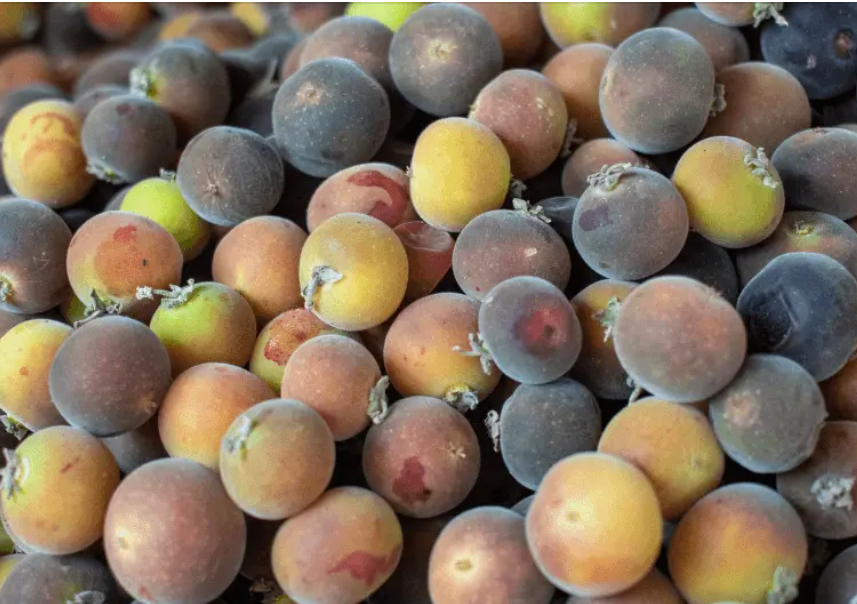
About the speciesABOUT THE SPECIES — Harvested Dovyalis hebecarpa fruit, showing the velvety skin and the shift from orange toward deep purple as it ripens. Fruit is not included; this listing is a live plant.
Tropical Fruit Plants
Ketembilla (Ceylon Gooseberry) Live Plant – 6–10"
Dovyalis hebecarpa
Dovyalis hebecarpa • Ceylon Gooseberry • Purple Gooseberry
$19.49for live plant
LIVE PLANT
FREE SHIPPING
In stock — live plants are carefully prepared and dispatched within 1–2 business days
You are purchasing ONE live Dovyalis hebecarpa plant approximately 6–10 inches tall. Fruit is not included. FREE SHIPPING.
1
One live Dovyalis hebecarpa (Ketembilla / Ceylon Gooseberry) plant approximately 6–10 inches tall. Fruit not included. Free shipping.
- Free shipping on this listing
- Secure encrypted checkout
- Carefully packed in Puerto Rico
- Detailed growing guide included
- Scientific name
- Dovyalis hebecarpa (Gardner) Warb.
- Family
- Salicaceae
- Origin
- Sri Lanka and southern India
- Product type
- Live plant
- Size
- Approximately 6–10 inches tall
- Habit
- Spiny shrub to small tree
- Light
- Full sun once established
- Soil
- Well-drained; adaptable
Ketembilla is a fruiting shrub from Sri Lanka and southern India, where its name comes from Sinhala. Over the last century it was carried to tropical gardens and research stations around the world, and it is now found as an introduced plant in places such as Florida, Hawaii and Puerto Rico.
It belongs to Salicaceae — the willow family in its modern, expanded sense — and is a close relative of the Kei apple (Dovyalis caffra) and the Abyssinian gooseberry (Dovyalis abyssinica). It grows into a bushy shrub or small tree, often with long, sharp spines along the branches, and makes a dense, productive hedge.
The fruit is the reason to grow it: round berries about an inch across, covered in fine velvety hairs, ripening from green through orange to a dusky maroon-purple. The juicy flesh is strongly acidic with a berry-like depth, often compared to a sharp gooseberry or cranberry. It is prized for jams, jellies, syrups and juices, and fully ripe fruit is eaten fresh by those who enjoy tartness.
This plant is sold as the species. We do not claim a cultivar, a fruiting age or that a single plant will set fruit on its own.
What You Receive
- One live Dovyalis hebecarpa (Ketembilla) plant
- Approximately 6–10 inches tall
- Natural variation in height, foliage, branching and appearance
- No cultivar claimed; plant sex unknown until flowering
- Fruit is not included
- Free shipping
You are purchasing ONE live Dovyalis hebecarpa plant approximately 6–10 inches tall. Fruit is not included. FREE SHIPPING.
Live Plant — Fruit Is Not Included
Fruit photographs show the species for reference. You receive the young plant pictured as WHAT YOU RECEIVE.
Fruiting age, yield and fruit set are not guaranteed, and a single plant may not fruit on its own.
A few leaves may drop after shipping as the plant adjusts. This is normal.
First weeks at home
Establishing Your Ketembilla
- 1
Unpack promptly
Open the box on arrival, stand the plant upright and handle it by the pot, not the stem.
- 2
Check moisture
Water thoroughly if the mix is dry and let excess drain freely.
- 3
Rest in bright shade
Keep the plant out of direct midday sun for the first 5–7 days.
- 4
Acclimate to sun
Increase direct sun gradually over one to two weeks; established plants fruit best in full sun.
- 5
Pot up
Once new leaves appear, move to a pot one size larger with free-draining mix, keeping the same soil level.
- 6
Feed lightly
Start gentle balanced feeding when growth is active.
CORRECT ✓
Full sun after acclimation, fast drainage, deep but infrequent watering once established, and early shaping.
AVOID ✕
Waterlogged soil, full sun on arrival, planting beside walkways where spines are a hazard, and heavy feeding of a stressed plant.
Growth Habit and Spines
Ketembilla forms a multi-stemmed shrub with arching branches and glossy leaves, eventually reaching several meters if unpruned. The branches can carry long, sharp spines, which is why it has traditionally been used as a living barrier hedge.
Fresh fruit FAQ
Questions about fresh cacao pods
- Does Ketembilla have thorns?
- Often, yes. Many plants develop sharp spines on older branches, so place it away from paths and wear gloves when pruning. Young plants may show few spines at first.
- Will one plant produce fruit?
- Not necessarily. Dovyalis species commonly have separate male and female plants, and plant sex cannot be seen until flowering. Growing more than one plant improves the chance of fruit set.
- Is it related to true gooseberries?
- No. 'Gooseberry' describes the tart flavor. True gooseberries are Ribes; Ketembilla is in Salicaceae.
- Can it grow in a pot?
- Yes while young, and it tolerates pruning well. For long-term fruiting it performs best planted in the ground in warm climates.
Flowers and Reproduction
Flowers are small, greenish and lack petals, appearing in the leaf axils. In Dovyalis, male and female flowers are typically borne on separate plants, so a lone plant may flower without fruiting. Growers who want fruit usually plant several.
Fresh fruit FAQ
Questions about fresh cacao pods
- Does Ketembilla have thorns?
- Often, yes. Many plants develop sharp spines on older branches, so place it away from paths and wear gloves when pruning. Young plants may show few spines at first.
- Will one plant produce fruit?
- Not necessarily. Dovyalis species commonly have separate male and female plants, and plant sex cannot be seen until flowering. Growing more than one plant improves the chance of fruit set.
- Is it related to true gooseberries?
- No. 'Gooseberry' describes the tart flavor. True gooseberries are Ribes; Ketembilla is in Salicaceae.
- Can it grow in a pot?
- Yes while young, and it tolerates pruning well. For long-term fruiting it performs best planted in the ground in warm climates.
The Fruit and Its Uses
Ripe fruit is dark purple-maroon, velvety and very juicy, with a bright acidity. It is most often cooked into jams, jellies and syrups, blended into juices, or eaten fresh when fully ripe with a sprinkle of sugar.
Fresh fruit FAQ
Questions about fresh cacao pods
- Does Ketembilla have thorns?
- Often, yes. Many plants develop sharp spines on older branches, so place it away from paths and wear gloves when pruning. Young plants may show few spines at first.
- Will one plant produce fruit?
- Not necessarily. Dovyalis species commonly have separate male and female plants, and plant sex cannot be seen until flowering. Growing more than one plant improves the chance of fruit set.
- Is it related to true gooseberries?
- No. 'Gooseberry' describes the tart flavor. True gooseberries are Ribes; Ketembilla is in Salicaceae.
- Can it grow in a pot?
- Yes while young, and it tolerates pruning well. For long-term fruiting it performs best planted in the ground in warm climates.
Climate and Siting
It thrives in warm tropical and subtropical lowlands with good drainage and full sun. Young plants need protection from frost, and in cooler areas it is best kept in a container that can be moved indoors.
Fresh fruit FAQ
Questions about fresh cacao pods
- Does Ketembilla have thorns?
- Often, yes. Many plants develop sharp spines on older branches, so place it away from paths and wear gloves when pruning. Young plants may show few spines at first.
- Will one plant produce fruit?
- Not necessarily. Dovyalis species commonly have separate male and female plants, and plant sex cannot be seen until flowering. Growing more than one plant improves the chance of fruit set.
- Is it related to true gooseberries?
- No. 'Gooseberry' describes the tart flavor. True gooseberries are Ribes; Ketembilla is in Salicaceae.
- Can it grow in a pot?
- Yes while young, and it tolerates pruning well. For long-term fruiting it performs best planted in the ground in warm climates.
Common Mistakes
- Expecting fruit from a single plant
- Keeping the soil constantly wet
- Moving directly into full sun
- Letting it grow unshaped until spines make pruning difficult
- Planting next to paths or play areas
Fresh fruit FAQ
Questions about fresh cacao pods
- Does Ketembilla have thorns?
- Often, yes. Many plants develop sharp spines on older branches, so place it away from paths and wear gloves when pruning. Young plants may show few spines at first.
- Will one plant produce fruit?
- Not necessarily. Dovyalis species commonly have separate male and female plants, and plant sex cannot be seen until flowering. Growing more than one plant improves the chance of fruit set.
- Is it related to true gooseberries?
- No. 'Gooseberry' describes the tart flavor. True gooseberries are Ribes; Ketembilla is in Salicaceae.
- Can it grow in a pot?
- Yes while young, and it tolerates pruning well. For long-term fruiting it performs best planted in the ground in warm climates.
Why grow it
Why grow Ketembilla?
Unusual Sri Lankan fruit shrub
Tart, deeply colored purple fruit
Classic for jams and juices
Doubles as a dense hedge
Free shipping
You may also like
Related products