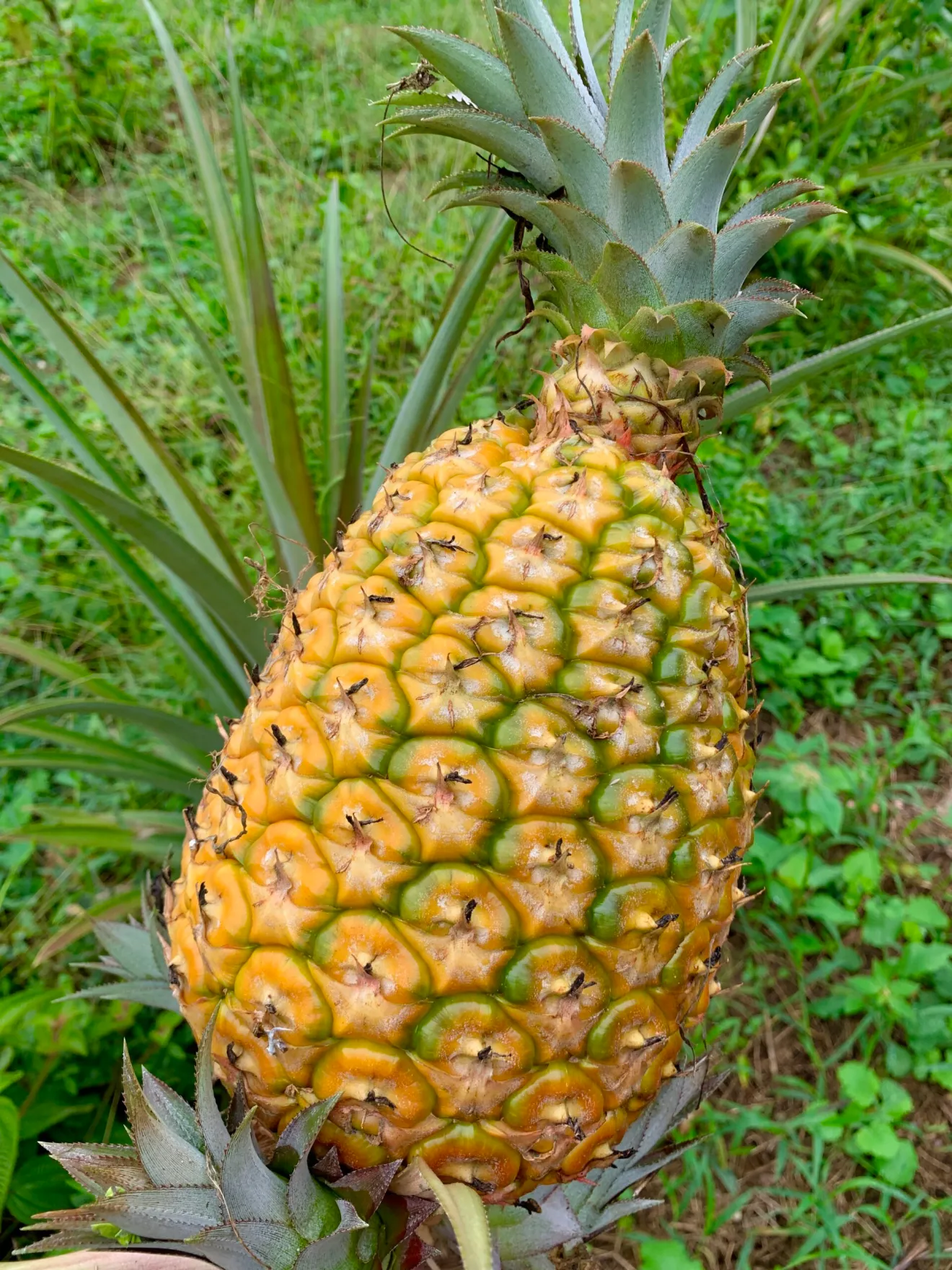
About the speciesAbout the species — a pineapple developing on an established plant. FRUIT NOT INCLUDED — this listing is for 3 live pineapple suckers. No fruit size, sweetness, color or fruiting date is claimed or guaranteed.
Tropical Fruit Plants
3 Puerto Rico Pineapple Suckers
Ananas comosus (L.) Merr.
Ananas comosus • Piña del País • Viña de Espina
$21.98for 3 live pineapple suckers
LIVE PINEAPPLE SUCKERS
FREE SHIPPING
In stock — live plant material is prepared and dispatched within 1–2 business days
YOU RECEIVE: 3 LIVE PINEAPPLE SUCKERS. These are NOT seeds, and this listing does NOT include pineapple fruit.
1
Three live Puerto Rico pineapple suckers (Ananas comosus), known locally as piña del país / viña de espina. Vegetative offshoots ready to plant — not seeds, and fruit is not included. Packed in Puerto Rico. Free shipping.
- Free shipping on this listing
- Secure encrypted checkout
- Carefully packed in Puerto Rico
- Detailed growing guide included
- Scientific name
- Ananas comosus (L.) Merr.
- Family
- Bromeliaceae
- Product type
- Live vegetative plant material — pineapple suckers / offshoots
- Quantity
- 3 live pineapple suckers
- Local names
- Piña del país, Viña de espina
- Propagation
- Vegetative offshoots — no seeds involved
- Climate
- Tropical / warm frost-free conditions
- Light
- Bright protected light on arrival; strong light to full sun once established and acclimated
- Water
- Water thoroughly, then let excess drain freely — never continuously waterlogged
- Soil
- Light, airy, sharply free-draining medium
- Planting depth
- Base secured in the medium; the center of the rosette stays above the soil line
- Growth habit
- Rosette of stiff spiny leaves around a short central stem
- Container growing
- Suitable, provided the pot drains freely and is stable as the rosette widens
- Cold sensitivity
- Not frost hardy — protect from cold
- Difficulty
- Beginner-friendly if drainage is good
Pineapple, Ananas comosus (L.) Merr., is a terrestrial bromeliad in the family Bromeliaceae, grown across the tropics as a perennial fruit plant. Unlike most fruit trees, pineapple is almost never started from seed in cultivation. It is propagated vegetatively — from crowns, slips and suckers taken from plants that are already growing.
This listing is for THREE live suckers: offshoots that arise from an established pineapple plant and can be planted directly to start new plants. Because a sucker already carries a developed leaf rosette and a firm base, it establishes as a plant rather than having to pass through a seedling stage.
The planting material is grown in Puerto Rico and offered under the local names piña del país and viña de espina. These are regional names used for this planting material — no named cultivar, hybrid, clone or protected variety is claimed.
YOU RECEIVE 3 LIVE PINEAPPLE SUCKERS. These are NOT seeds, and this listing does NOT include pineapple fruit. Fruit photographs illustrate the species only.
What You Receive
- 3 live pineapple suckers / offshoots
- Carefully selected for planting
- Shipped without fruit
- Vegetative plant material — not seeds
- Free shipping
- Species-specific pineapple growing guide
YOU RECEIVE: 3 LIVE PINEAPPLE SUCKERS. These are NOT seeds, and this listing does NOT include pineapple fruit.
Live Plant Material Notice — Not Seeds, Fruit Not Included
This listing is for THREE LIVE PINEAPPLE SUCKERS. It is not a seed listing and pineapple fruit is NOT included. Fruit photographs identify the species only.
Piña del país and viña de espina are Puerto Rican names used for this planting material. No named cultivar, hybrid, clone or protected variety is claimed, and no specific mature fruit size, sweetness, acidity, color, yield or fruiting date is promised.
Shipping temporarily changes light, humidity, airflow and temperature. Bent, dry-tipped or cosmetically marked leaves on arrival are common and do not automatically mean the plant material is unhealthy.
Living plant material varies naturally. Size, leaf shape, coloration and minor imperfections differ between individual suckers, and you will not necessarily receive the exact photographed specimen.
Planting
How to Plant Your Pineapple Suckers
- 1
Inspect the sucker after arrival
Unpack promptly and look over the base and the leaf rosette. Remove any loose, decayed or badly damaged lower leaves so the base is clean and firm.
- 2
Choose a container or site with excellent drainage
Pineapple resents standing water far more than it resents dryness. Use a pot with generous drainage holes and an airy medium, or a garden position where water never sits.
- 3
Plant the basal portion securely
Set the firm base into the medium deeply enough that the sucker stands up on its own and does not rock in wind, and firm the medium around it.
- 4
Keep the rosette above the soil line
Never bury the center of the rosette. Soil packed into the growing point traps moisture and is one of the most common causes of rot.
- 5
Start in bright, protected light
After transit, give bright light with shelter from the harshest midday hours rather than immediate all-day sun.
- 6
Keep it warm
Pineapple establishes best in consistently warm conditions. Cold, wet conditions slow rooting and increase the risk of basal rot.
- 7
Water thoroughly, then let it drain
Water well, allow the excess to drain away completely, and let the medium dry somewhat before watering again. Avoid a continuously saturated root zone, especially before roots are active.
- 8
Acclimate to strong light once established
As the plant anchors and pushes new leaves from the center, increase sun exposure gradually toward strong light or full sun appropriate to your climate.
Pineapple Is a Bromeliad
Pineapple belongs to Bromeliaceae, the bromeliad family, and it shows: the plant is a rosette of stiff, channeled leaves arranged around a short central stem, growing in the ground rather than perched on a tree like many of its epiphytic relatives.
That architecture explains most of its care. Water is shed down the leaves toward the base, the growing point sits protected at the center of the rosette, and the root system is comparatively modest — which is precisely why free drainage and air at the root zone matter more than constant moisture.
The pineapple itself is not a single fruit. An inflorescence of many individual flowers develops and fuses into one compound (multiple) fruit, topped by the leafy crown. Each 'eye' on the surface corresponds to one of those original flowers.
About Piña del País / Viña de Espina
This is Puerto Rican-grown pineapple planting material, offered under the local names piña del país and viña de espina. In Puerto Rico pineapple is a familiar dooryard and small-farm plant, grown along the edges of home gardens and in mixed plantings where the sun is strong and the soil drains.
These names are how the material is known locally. They are not being presented as a formal cultivar identity — this planting material is not identified as MD-2, Smooth Cayenne, Red Spanish, Cabezona, Pernambuco, Queen or any other named variety, and no such claim is made.
What we can say plainly is what it is: live vegetative offshoots from established pineapple plants, grown in Puerto Rico and prepared for planting.
Suckers, Slips and Crowns
Pineapple offers the grower several kinds of vegetative planting material, and the names describe where each one comes from on the mother plant.
The crown is the leafy top of the fruit itself. Slips arise on the stalk just beneath the fruit. Suckers (also called pups) emerge lower down, from the stem among the leaves of the established plant. All are clonal offshoots of the same plant.
Suckers are widely used planting material in pineapple cultivation because they leave the mother plant already sized and structured as small plants rather than as a detached fruit top.
The Pineapple Life Cycle
A pineapple plant grows its rosette for a long vegetative period, then flowers and develops a single fruit from that rosette. That particular rosette will not fruit a second time; after fruiting it gradually declines.
Before and during that decline, however, the plant produces offshoots — suckers and slips — from the stem. Those offshoots carry the planting cycle forward, which is why a pineapple patch can continue for years from material it produces itself.
This is the reason vegetative propagation sits at the center of pineapple cultivation worldwide: the plant hands the grower its own replacements. Timing varies widely with climate, plant vigor, planting material and management, so no fruiting date or number of offshoots is promised.
Drainage Matters More Than Constant Moisture
If there is one thing to get right with pineapple, it is drainage. The species is particularly sensitive to poorly drained and waterlogged conditions, and basal rot in newly planted suckers is far more often caused by too much water than by too little.
Practically: use an airy medium, water thoroughly so the whole root zone is wetted, let all the excess run out, and then let the medium dry somewhat before the next watering. Never leave a pot standing in a saucer of water.
Be especially restrained before roots are active. A freshly planted sucker has little capacity to take water up, so a soaked medium simply stays wet around its base.
Container Growing
Pineapple grows well in containers as long as the pot drains freely, the medium is open and airy, and the container gives the plant enough room and physical stability as the rosette widens.
A wide, reasonably heavy pot is preferable to a tall narrow one: the rosette spreads outward and a top-heavy plant in a light pot tips easily. Step the plant up gradually rather than starting a small sucker in a very large volume of medium, which stays wet too long.
Container culture also makes it practical to grow pineapple outside the tropics, since the plant can be moved into shelter when temperatures drop.
First Days After Shipping
- Unpack promptly — do not leave the box closed after delivery.
- Inspect the base of each sucker and clean off loose or decayed lower leaves.
- Plant promptly in a well-draining medium.
- Avoid waterlogged soil; water thoroughly once, then let it drain and dry somewhat.
- Provide bright but protected light at first, sheltered from harsh midday sun and wind.
- Acclimate gradually to stronger outdoor sun over the following weeks.
- Do not panic over minor bent, dry-tipped or cosmetically marked leaves — that is normal transit wear.
About Pineapple Fruit
Pineapple is an aromatic tropical fruit eaten fresh and used widely in juices, cooking, preserves and desserts, from savory dishes to baked goods.
Fruit characteristics depend on the plant, the climate, the soil, the season and how the plant is grown. Fruit photographs on this page identify the species and are not included with this listing, and no exact fruit size, sweetness, acidity, color or fruiting timeframe is guaranteed.
Common Mistakes
- Planting too deeply, which smothers the base.
- Burying the center of the rosette, trapping moisture in the growing point.
- Waterlogged soil or a heavy, water-retentive medium.
- Containers without adequate drainage, or pots left standing in water.
- Exposing shipping-stressed plants to harsh full sun immediately.
- Prolonged cold exposure — pineapple is not frost hardy.
- Excessive watering before the sucker has rooted and become active.
Why grow it
Why grow pineapple from suckers?
Live vegetative planting material — no seed stage
Three suckers per order, grown in Puerto Rico
Terrestrial bromeliad with striking rosette form
Container-friendly wherever drainage is good
Established plants produce their own offshoots for the next cycle
Free shipping and a species-specific growing guide
You may also like
Related products